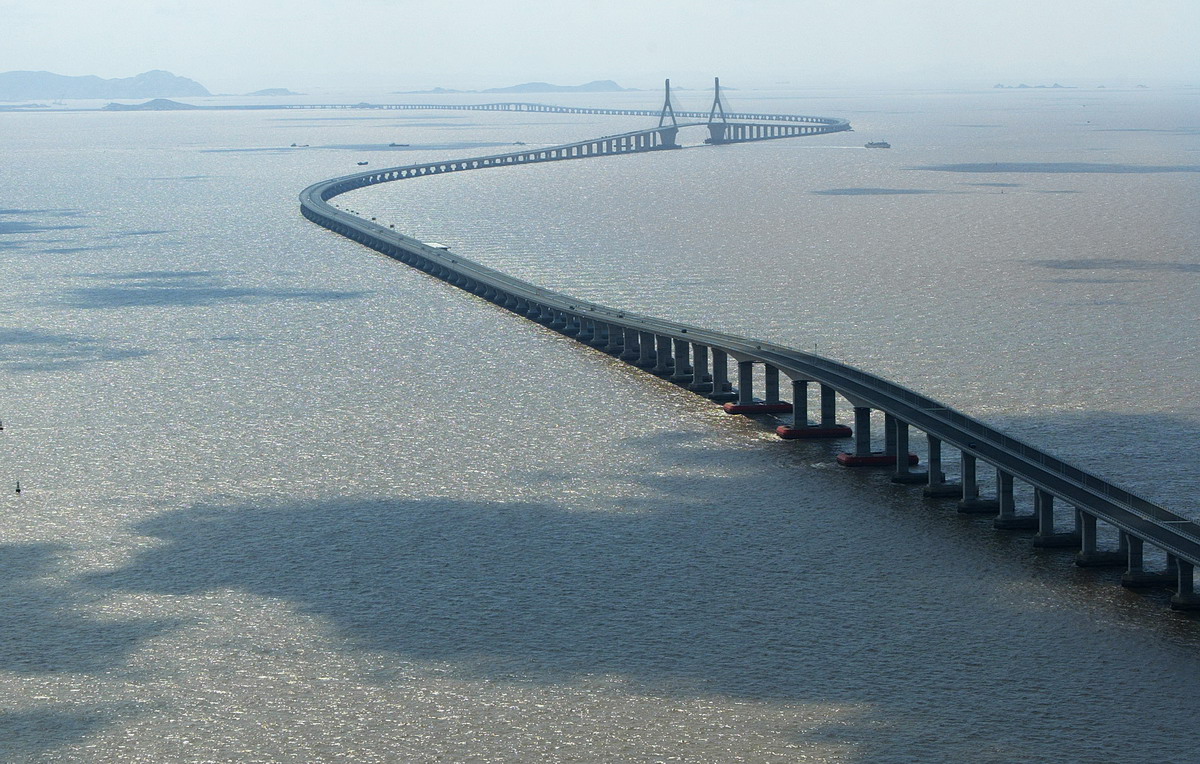
 China's Donghai Bridge, the longest bridge in the world. Image from wikimedia.org
Sunday, March 14, 2010
The Last Stretch
I saw a lecture on TED by Sendhil Mullainathan, a behavioral economist from Harvard University. He spoke of the problem of the “last mile” (the last stretch of a figurative bridge that links points A and B): the failure on behavioral level to adopt the solution to a problem. The example he gave was diarrhea and oral hydration therapy. The latter is the best solution to the former, to date, but there are still a significant number of deaths every year due to diarrhea in areas where oral hydration salts are readily available—they are simply not being utilized. Giving people more data does not help in convincing them to adopt this solution, Mullainathan said. This reminds me of my first class in introductory social psychology with E. Tory Higgins, where he said that humans are faulty computers. We do things in systematic ways, but our cognitive models are simply flawed sometimes. Mullainathan emphasized the importance of adding more effort on this “last mile”—finding out why people are not doing what has been proven to be good for them. This is a practical and logical approach, as the efforts devoted to technological/medical research, distribution and adoption are markedly disproportional to one another. His stand resonates with my ongoing study of increasing clinical trial participation and raising its standard. Without the last mile, the bridge would never connect points A and B.
 China's Donghai Bridge, the longest bridge in the world. Image from wikimedia.org
China's Donghai Bridge, the longest bridge in the world. Image from wikimedia.org
Subscribe to:
Post Comments (Atom)

No comments:
Post a Comment